Retirement
Milestones

Start Early for Higher Confidence

Seizing your retirement planning early can help you get your savings on track. The path to retirement is challenging for each generation, but with better financial education, smart steps, and strategic planning, we can help you navigate the hurdles successfully.


There are a number of important financial opportunities on your journey to and through retirement. We are here to help guide you every step of the way.

50 years old

Annual contribution limits for a Traditional or Roth IRA increase at age 50. Contribution limits for certain employer-sponsored plans also increase. Talk to your plan administrator or employer to help determine how these additional deferral amounts can be accommodated.

55 years old

You can make “catch-up” contributions to your HSA at work when you turn 55. There’s also a special exception for penalty-free distributions from qualified plans at age 55. And if you’re considering an IRA rollover, keep in mind that IRAs do not have a pre-59 1/2 exception for separation from service.

591/2 years old

Most retirement accounts can be accessed for any reason without a 10% additional tax penalty at this age. Most qualified plans allow for an in-service non-hardship withdrawal. If you’re working and looking to diversify by rolling funds from a qualified plan to an IRA, this is the age when you are able to do so.

60 years old

If you've lost a spouse, age 60 is when you become eligible to collect a Social Security survivor’s benefit. Survivor benefits collected prior to Full Retirement Age will be reduced. It’s important to evaluate survivor’s benefits, individual benefits, and work status when choosing the best claiming strategy.

62 years old

The month following your 62nd birthday is when you become eligible to collect Social Security retirement benefits. Unless disabled, the individual benefit at age 62 will be 70–75% of the full retirement benefit. Any benefits collected prior to Full Retirement Age are subject to the earnings limit and earned income may be reduced.

65 years old

The month you turn 65 is when you become eligible for Medicare. Most people will be eligible for premium-free Part A coverage. Unless covered by an employer-sponsored health plan, you must also enroll in Medicare Part B to avoid penalties. If you continue to work, check if your employer’s plan integrates with Medicare.

66-67 years old

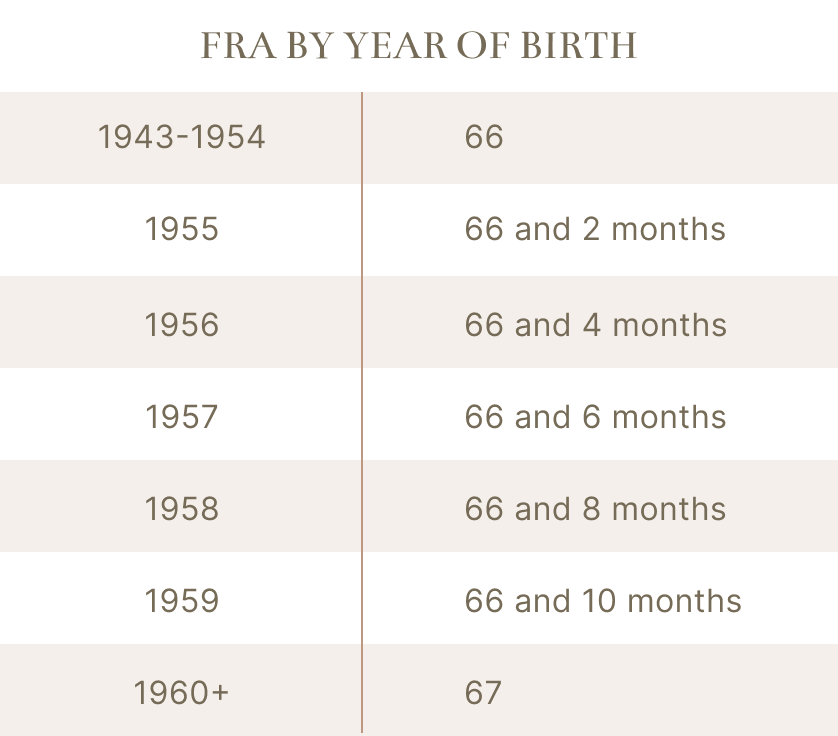
Full Retirement Age (FRA) for Social Security is based on the year in which you were born. Assuming you’re not receiving a retirement or disability benefit yet, in the month following your attainment of FRA, you’re eligible to collect your full retirement benefit.


72-75 years old

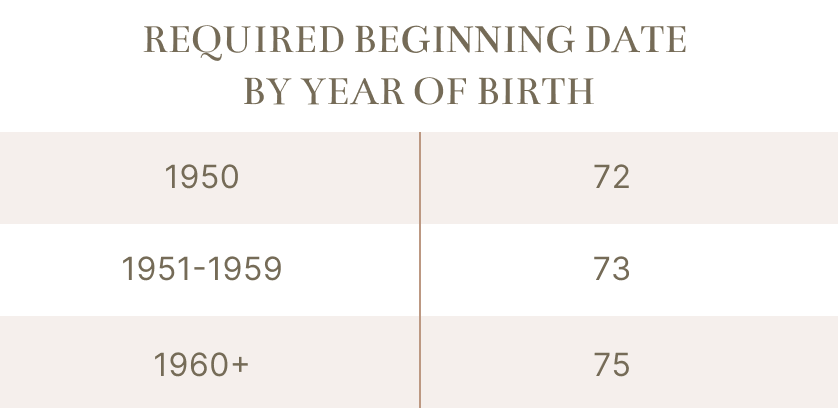
The year in which you reach the required beginning date is referred to as the “first distribution year” and required minimum distributions (RMDs) from qualified accounts must begin. The IRS allows the first RMD to be postponed until April 1 of the year following the “first distribution year.” Subsequent RMDs are due by year end of each year.


Keep Your Eyes Fixed on the Horizon

Let's embark on your financial journey together and discover how your aspirations can shape a future of financial success.

Contact Us